# Where Light Breaks: Five Wild Places to Reset Your Compass
There are moments in travel when the sky finishes the landscape for you — when ridges, rocks and water become a stage and light shows you something you didn’t know you were looking for. I write this from the road: sand grinding in my boots, camera warm in my hands, and a map of small kindnesses in my head. Below are five places that have rearranged my sense of scale and patience. Each scene is paired with how to enter it well — practical tips, a little local context, and a reminder to leave places better than you found them.
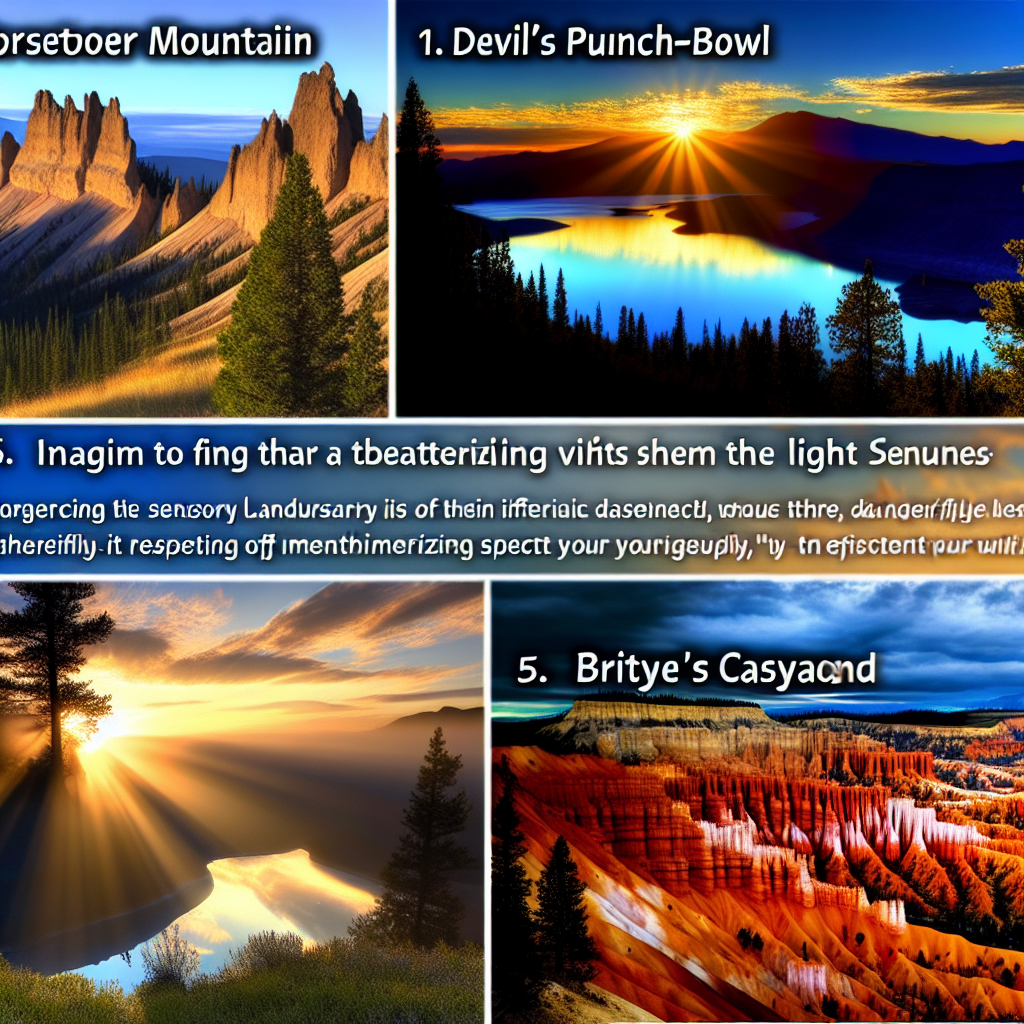
## Horsetooth Mountain, Fort Collins — Sunset on the Front Range
Horsetooth’s sandstone fins cut the plains like a set of piano keys. At dusk the rocks seem to hold heat — the honey grain glowing slowly from gold into magenta — and the wind carries a scent of dry grass and distant hay smoke. Trail runners pass in single-file bursts of effort; climbers cling like dark punctuation marks. I find a ledge, sit, and watch shadows compress the valley into a whisper.
Why go: Close to town and impossibly cinematic at sunset, this ridge gives you the Front Range in a single, wide breath.
How to experience it: Aim to be on the ridge 30–45 minutes before sunset. Wear shoes that grip—you’ll thank yourself on loose gravel—and bring a headlamp for the walk back. Treat the area with humility: it sits within working ranch and watershed country and on lands long stewarded by Indigenous peoples such as the Arapaho and Ute. Ask locally about cultural history, support Fort Collins guide services, and pack out everything you bring in.
Cultural note: If you stop at a nearby café afterward, ask the barista where they source their beans. Small conversations about local suppliers help direct tourism dollars where they matter.
## Devil’s Punchbowl, Lincoln City, Oregon — The Sea Carving Its Theater
Here the ocean is a sculptor that never tires. Waves funnel into a basalt bowl and explode into a roiling, glittering curtain; the spray tastes of iron and salt. Storm-clearing light sends columns of sun through the haze, and gulls write impatient lines across the sky. People come in bursts — families at low tide, photographers chasing surf at high — but even in a crowd the place feels like a live performance you didn’t script.
Why go: Compact and dramatic, Devil’s Punchbowl is unforgettable when the swell is right and the clouds break just long enough for the light to punch through.
How to experience it: Check tide charts and weather; a mid-to-low tide reveals tidepools, while high surf delivers the punchbowl’s theatrics (keep a safe distance). Layer up — the coast can be damp and sudden in temperature shifts — and wear shoes with good traction. Learn about the Siletz and other coastal tribes who have long connections to these shores; consider visiting a local interpretive center to deepen your understanding.
Practical tip: Support nearby small businesses in Lincoln City rather than relying on chain outlets — your dollars stay in place and sustain local conservation and culture.
## North Cascades, Washington — Layers of Mountain Silence
The Cascades can read like a monochrome painting: ridgelines stacked in receding blues, glaciers bright and austere, forests dark as velvet. At certain light the peaks separate into distinct planes, and your breath matches the slow, measured rhythm of the mountains. On the trail I meet a ranger who points out a recent avalanche line; we talk about the wilder things that move here and the quiet work of restoration.
Why go: This is mountain wilderness in near-pure form — meadows, high passes, and viewpoints that feel older than the road you drove in on.
How to experience it: For the best “layered” effect, choose a high viewpoint at sunrise or late afternoon. Bring rain gear, warm layers, and bear-aware supplies (bear spray, scent-proof storage). Weather changes quickly; give yourself time to move safely. Learn which tribes’ homelands you are entering and consider hiring local guides who can explain ecological and cultural stewardship efforts.
On the trail: Walk softly and slow your internal schedule. The North Cascades reward patience more than speed.
## Mirror Lakes, New Zealand — Quiet as a Camera Shutter
Come before dawn and you’ll meet a surface so still it feels like a held breath. Mirror Lakes returns the world in doubled clarity: beech forest, jagged peaks, and clouds that look like chalk on blackboard. The only sounds are a lone bird, an occasional footstep on the boardwalk, and the whisper of water against stone.
Why go: Minimal effort, maximal reward — especially for morning light that turns the scene into a living painting.
How to experience it: Arrive at first light to avoid crowds and capture flawless reflections. Stay on boardwalks to protect fragile wetlands. Learn a few te reo Māori phrases and the name of the iwi (tribe) that cares for this land — in many parts of Te Waipounamu (the South Island), Ngāi Tahu are key kaitiaki (guardians). Visiting with curiosity and respect adds depth to what you see.
Cultural practice: When you buy a meal or a tour, ask staff about local suppliers and Māori-owned businesses. Small choices help keep cultural knowledge flourishing.
## Bryce Canyon, Utah — Hoodoos and Hourglass Light
Bryce is less a canyon than an amphitheater of hoodoos: spires and fins that gather and spill light like a choir. At sunrise the orange stone turns luminous and immediate; at certain angles the shadows between the columns are almost musical. I like to get down into the amphitheater before dawn, where the formations feel like an old city under slow construction.
Why go: The hoodoos create a surreal landscape of scale and detail that reads differently with every hour and weather change.
How to experience it: Hike rim-to-rim connectors or descend into the amphitheater at first light for quieter interiors. The elevation is high — hydrate, take it slow, and watch for sudden storms. These formations are fragile; stay on trails and respect closures. Acknowledge that this land is ancestral to Southern Paiute peoples and learn about the stories and stewardship that tie people to place.
Gear & Ethical Notes
– Light and timing matter: Golden hour and calm mornings make the difference between a nice photo and an unforgettable one. Be patient, and plan for wait time.
– Pack light, pack right: layers, water, snacks, a small first-aid kit. A tripod is worth its weight for low-light work; polarized and neutral-density filters expand creative options.
– Learn the land’s story: Look up the Indigenous nations whose territories you’re visiting and, when possible, support Indigenous guides, artisans and cultural programs.
– Be small and leave little: Stay on trails, avoid trampling vegetation, and pack out all waste. These places endure when we treat them as temporary guests.
Takeaway
These five scenes are different chapters of the same slow book: geological patience, weather’s hand, and human humility. Travel that matters is not about ticking boxes but about learning how to be a better guest — arriving early, listening to local stories, and letting light reframe what you thought you knew. When your next trip brings you to a ridge, a shore, or a glassy lake, what will you notice if you move more slowly and ask one simple question: how can I leave this place better than I found it?